I’m writing a research paper that I spent months coding for. Okay, maybe I should use an em dash here… wait… never mind… it’s not worth the risk!
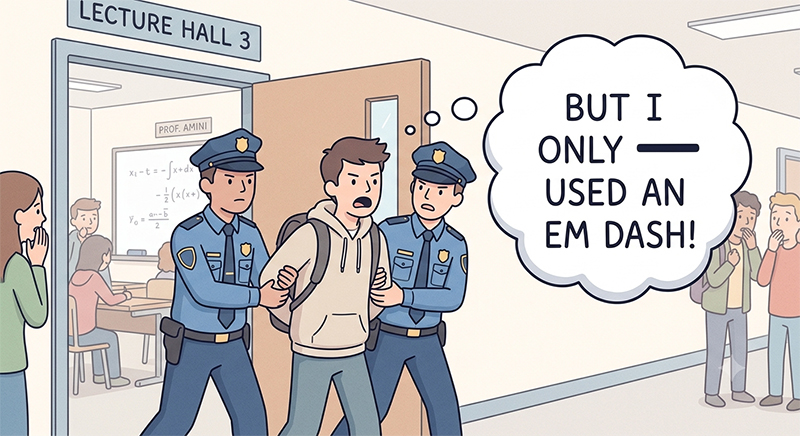
The New Fear of a Classic Mark
I’m writing a research paper that I spent months coding for. Okay, maybe I should use an em dash here… wait… never mind… it’s not worth the risk! I’ll just stick to parentheses.
Does this feeling sound familiar? My guess is yes. Once upon a time, this punctuation mark was the darling of writers and editors, helping make complex sentences clearer. But these days, using it is practically a red flag that you hired an AI model to write your paper or LinkedIn post. Honestly, I get the exact same feeling whenever I see one (:
Students and researchers are so terrified of this mark that before submitting a paper to an advisor or a journal, they hunt down and wipe out every em dash like someone trying to cover their tracks. They’re worried AI detectors (the main suspect in this whole mess) will treat a simple dash as evidence of academic misconduct.
The funny thing is that according to recent research (I took the time to read a few useful papers on this; I’ll drop the links at the end of the post), early models fell in love with em dashes because they were trained on millions of professionally edited texts and books. Simply put, they picked up the habit from us! But now, humans are forced to censor their own writing just so they don’t look like a robot trying to imitate a human. What’s hilarious is that newer models seem to have cut back on using them (they’re probably sick of us complaining about it).
In short, we’re sacrificing one of the most flexible writing tools out there over an unfounded suspicion. So, my friend, go ahead and use the “—” dash!
Postscripts
P.S. 1: This text was written by a sane, adult human — meaning myself — and not an AI! Though I’m not entirely sure about that part. As Hafez (the great Persian poet) puts it:
“On the pulpit, preachers, goodness display / Yet in private, they have a different way,”
P.S. 2: The attached image was created by AI without any physical or chemical intervention from any human — meaning myself. I hereby disclaim all responsibility for it!
References for Further Reading
-
Czuma, P. (2026). Em-ergence of the em-dash: a population-level rise in em-dash frequency in medRxiv preprints at the dawn of the large-language-model era. arXiv:2606.29540.
https://arxiv.org/abs/2606.29540 -
Freeburg, E. M. (2026). The Last Fingerprint: How Markdown Training Shapes LLM Prose. arXiv:2603.27006.
https://arxiv.org/abs/2603.27006 -
Dhesi, G. S. (2026). Why Large Language Models Seem to Overuse Em-Dashes: Evidence, Mechanisms, and Limits of a Widely Noticed AI-Writing Signal. University of Waterloo.
https://www.gunvir.ca/papers/why-llms-seem-to-overuse-em-dashes.html