3D Urban Modeling without GIS

This project details the methodology for creating a detailed 3D urban model of central Ilam city for microclimate simulation, achieved without relying on GIS data.
Project Overview
Accurate urban models are essential for understanding and simulating microclimate conditions, especially in relation to solar potential and energy consumption. This project addresses the challenge of creating such models in areas lacking readily available GIS data.
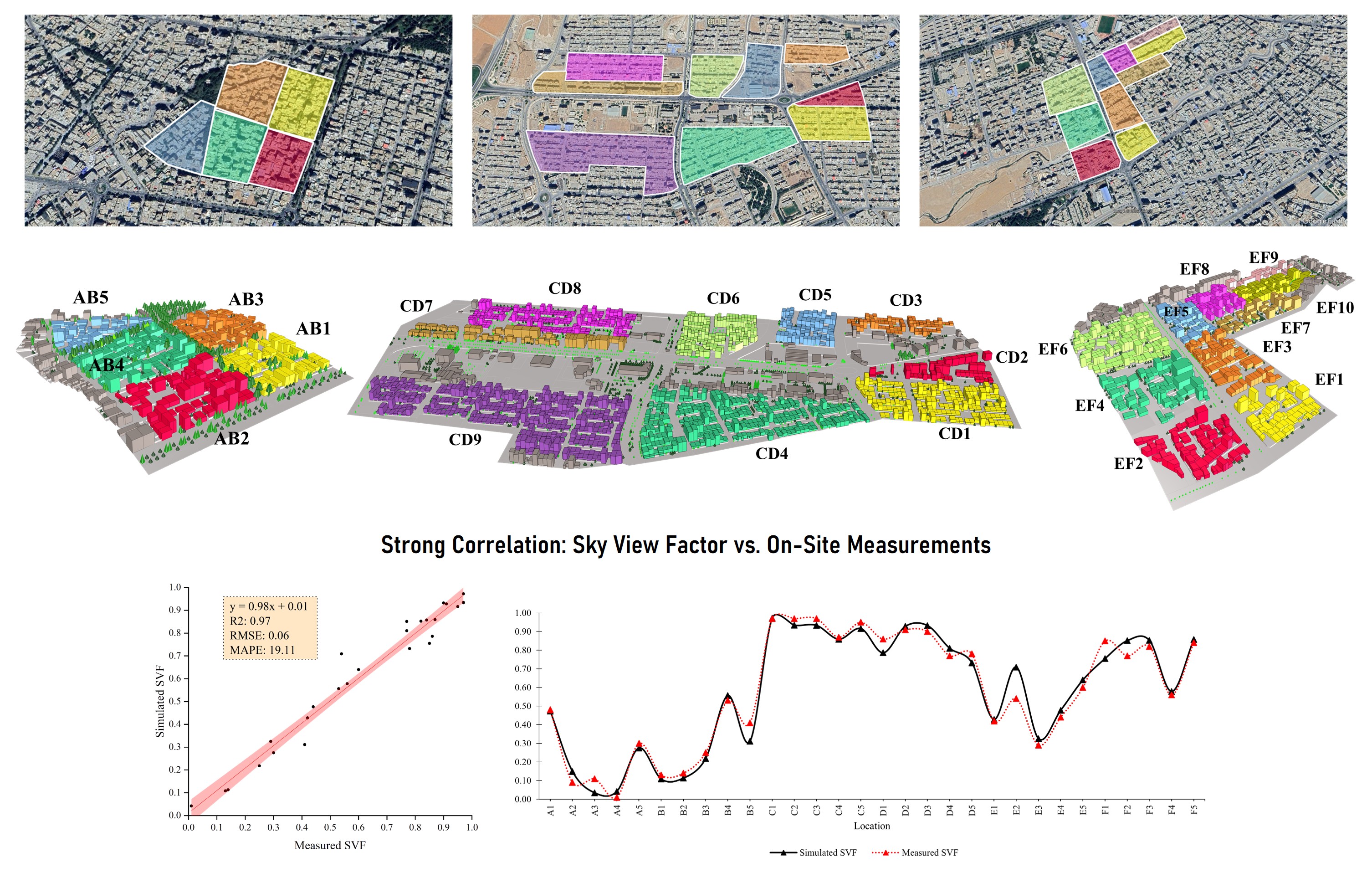
Methodology
-
1
Data Acquisition
Detailed architectural plans were collected from municipalities, together with high-resolution aerial photographs and on-site photography. In some cases, information was obtained directly from residents.
-
2
3D Modeling
Approximately 2,500 building models were created within the urban core of Ilam city, a labor-intensive process that took about 8 months.
-
3
Irregular Texture Simulation
The natural irregularity of the urban fabric was represented accurately, capturing detailed building shapes and adjacencies rather than assuming a simplified, regularized urban texture.
Key Innovation
Creating a large-scale, high-fidelity 3D urban model without GIS data represents a significant achievement in this field.
The model comprises approximately 2,500 buildings within the urban core of Ilam city. This methodology offers a viable approach for solar potential and energy consumption research in regions lacking robust GIS resources, a common limitation in many Iranian cities. It allows detailed building information to be modeled accurately even without such data.
Key Findings
The completed 3D model enabled detailed simulation of solar potential and energy consumption, revealing how the natural irregularity of urban texture significantly influences energy performance. These findings provide important insights for sustainable urban planning, especially in contexts with similar data limitations.
Related Publications
This project is closely related to publications on the impact of urban morphology on solar potential and energy consumption. Please see the Publications page for more information.